
How to reduce concentration risk without triggering capital gains
If you’ve built significant wealth through a single stock, whether from years of service at a publicly traded company, a successful business sale, or a long-held investment that outperformed expectations, you’re likely familiar with a difficult dilemma. On one hand, your concentrated position has served you well. On the other, holding too much of your portfolio in a single stock brings significant risk. Selling outright would trigger a substantial capital gains tax bill, but holding the position leaves your financial future and legacy vulnerable to the fate of a single company.
This is where an exchange fund can be a powerful tool. For investors with highly appreciated, concentrated stock positions, exchange funds offer a way to achieve meaningful diversification without triggering an immediate taxable event. Below, we’ll explore the risks of holding a concentrated position, what exchange funds are, how they work, and if one might be the right strategy for you.
Understanding Concentration Risk
Concentration risk is the danger of having too much of your wealth tied to a single investment. While a concentrated position can accelerate wealth creation on the way up, it can be equally destructive on the way down. History offers no shortage of examples. Investors who held large positions in companies like Lehman Brothers and GE watched billions in value disappear, often taking retirement plans and generational wealth with them. Even fundamentally strong companies are not immune to sharp, unexpected declines.
The data reinforces this reality. According to a Goldman Sachs study of the Russell 3000 index from 1986 to 2023, 99% of individual stocks experienced greater volatility than the broader index, and 41% experienced a sustained decline in value of over 75% without a material recovery. For investors holding a concentrated position, the question is not whether diversification makes sense, but how to achieve it without giving up a significant portion of gains to taxes. Exchange funds offer one of the most effective solutions to this exact problem
What Is an Exchange Fund?
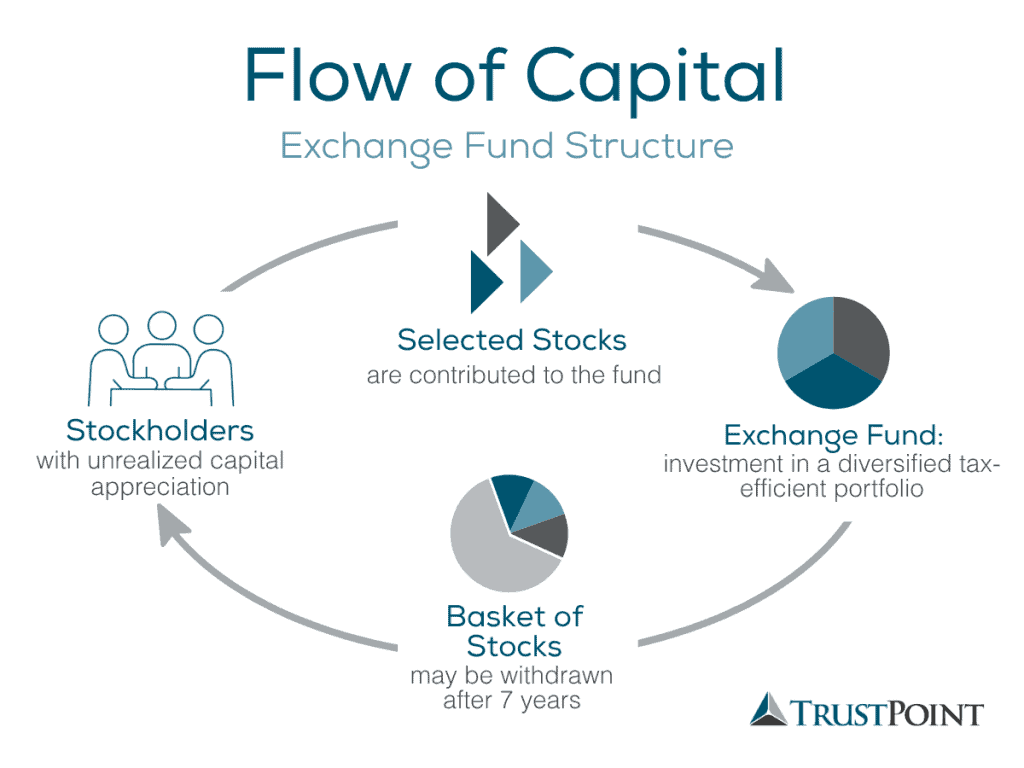
An exchange fund is a privately offered investment that allows investors to contribute their individual concentrated stock positions into a single, pooled fund. In return, each investor receives an interest in the diversified fund rather than holding shares of just one company.

The central advantage is that contributing shares to an exchange fund is generally not treated as a taxable sale, meaning investors can diversify without owing capital gains tax at the time of the exchange while continuing to benefit from pre-tax compounding. After seven years, the investor can withdraw from the fund and receive a diversified basket of stocks equal to the value of their interest in the fund.
How Does an Exchange Fund Work?
The mechanics of an exchange fund are straightforward in concept, though the legal and regulatory details require professional guidance. Here is a general overview of the process:
- Contribution: An investor contributes their appreciated stock into the fund alongside other investors. The original cost basis carries over to the investor’s interest in the partnership, preserving the tax-deferred nature of the transaction.
- Holding Period: Exchange funds typically require a minimum holding period of seven years. During this time, the investor’s capital is invested in the diversified pool, benefiting from broad market exposure rather than the volatility of a single stock.
- Distribution: At the end of the holding period, the investor receives a pro-rata distribution of the fund’s assets in the form of a diversified basket of stocks. The shares received may not be the same ones originally contributed, but the tax-deferred treatment generally remains intact.
Key Benefits of an Exchange Fund
- Tax-Efficient Diversification: The most compelling benefit is the ability to reduce concentration risk without triggering capital gains taxes. Rather than remaining exposed to company-specific risks such as earnings disappointments, regulatory issues, or sector downturns, investors gain broad market exposure while preserving their unrealized gains.
- Pre-Tax Compounding: Since no taxes are owed at the time of contribution, investors keep their full position at work in the market. This tax-deferred compounding over the seven-year holding period can make a meaningful difference in long-term wealth accumulation.
- Estate Planning Advantages: Exchange funds can also complement a broader estate plan by reducing portfolio volatility, which can simplify legacy planning strategies. Most notably, heirs who inherit either the fund interest or the diversified basket of stocks received upon distribution may benefit from a step-up in cost basis, potentially eliminating the deferred capital gains taxes entirely.
Important Considerations
While exchange funds offer meaningful advantages, there are a few things to keep in mind. Though options for liquidity are available, the fund is designed to be held for seven years to receive the full diversification benefits. Investors should also be aware that exchange funds issue a K-1 for tax reporting purposes, which should be factored into annual tax preparation. As with any tax-related strategy, it is essential to work with experienced legal and tax advisors to ensure the structure aligns with your specific financial situation.
Is an Exchange Fund Right for You?
If you hold a concentrated stock position ($750,000+) with a large, unrealized gain and would like to benefit from diversification in your portfolio without triggering a taxable event, an exchange fund could be right for your situation. Our team specializes in helping investors evaluate strategies like exchange funds within the context of their complete financial picture, including investment management, estate planning, and long-term wealth preservation. Contact us today to schedule a consultation and take the first step toward a more diversified, resilient portfolio.
View our Exchange Funds informational sheet to learn more.
Disclaimer: This content is educational in nature and is not intended as personalized investment, tax, or legal advice. Contact your relationship manager to discuss your specific situation.
By: Nolan Gaffney and Nick Brandt