

Understanding federal tax provisions is essential for making informed financial decisions. Changes in tax law can directly impact your taxable income, investment strategy, and long-term financial goals. This guide breaks down key tax considerations and provide practical strategies to help you monitor, manage, and potentially reduce your taxable income.
What Is Taxable Income and Why Does It Matter?
Taxable income is the portion of your income subject to federal income tax after deductions and exemptions are applied. It includes wages, investment income, retirement distributions, and other sources of earnings. Understanding how taxable income is calculated is critical because it determines your tax bracket and overall tax liability.
Key Strategies to Monitor and Manage Your Taxable Income
- Review income sources annually to identify tax exposure
- Leverage tax-advantaged accounts such as IRAs and 401(k)s
- Consider timing strategies for income and deductions
- Evaluate capital gains and losses to manage tax impact
- Coordinate with a financial professional to align tax strategy with long-term goals
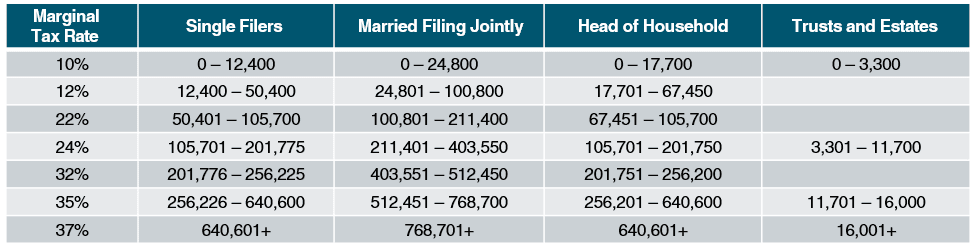
2026 Federal Income Tax Brackets
The IRS released updates federal income tax brackets adjusted for inflation, as detailed below.
Alternative Minimum Tax (AMT)
The alternative minimum tax (AMT), which applies to taxpayers with high economic income, increased to $90,100,100 for single filers and $140,200 for married filing jointly.

2026 Long-Term Capital Gains Tax Rates

2026 Standard Vs. Itemized Deductions

Tax Deductions and Details You May Be Overlooking
- Reinvested Dividends: When your mutual fund pays you a dividend or capital gains distribution, that income is a taxable event (unless the fund is held in a tax-deferred account, like an IRA). If you’re like most fund owners, you reinvest these payments in additional shares of the fund. The tax trap lurks when you sell your mutual fund. If you fail to add the reinvested amounts back into the investment’s cost basis, it can result in double taxation of those dividends.1
Mutual funds are sold only by prospectus. Please consider the charges, risks, expenses, and investment objectives carefully before investing. A prospectus containing this and other information about the investment company can be obtained from your financial professional. Read it carefully before you invest or send money. - Out-of-Pocket Charity: It’s not just cash donations that are deductible. If you donate goods or use your personal car for charitable work, these are potential tax deductions. Just be sure to get a receipt for any amount over $250.2
- State Taxes: Did you owe state taxes when you filed your previous year’s tax returns? If you did, don’t forget to include this payment as a tax deduction on your current year’s tax return. There is currently a $40,400 cap on the state and local tax deduction for 2026.3
- Medicare Premiums: You may be able to deduct unreimbursed medical and dental premiums, co-payments, deductibles, and other medical expenses to the extent that the costs exceed 7.5 percent of your adjusted gross income. This includes most Medicare premiums.4
- Income in Respect of a Decedent: If you’ve inherited an IRA or pension, you may be able to deduct any estate tax paid by the IRA owner from the taxes due on the withdrawals you take from the inherited account.5
2026 “Must-Know” Healthcare Taxes

Tax planning is not a one-time event; it’s an ongoing process that should evolve with your financial life. Trust Point Financial Professionals work with clients to develop proactive, tax-aware strategies designed to support long-term financial success. For a broader perspective on how tax strategies fit into your overall financial plan, explore our insights on comprehensive financial planning or contact our team.
FAQ’s
What increases taxable income?
Taxable income can increase from various factors, such as earned income, investment gains, retirement withdrawals, and reduced deductions.
How can I legally reduce taxable income?
Strategies may include contributing to tax-advantaged accounts, tax-loss harvesting, and timing income or deductions appropriately.
Why is it important to monitor taxable income each year?
Monitoring taxable income helps ensure you remain in an optimal tax bracket and avoid unexpected tax liabilities.
Sources
1. Investopedia.com, August 24, 2025
2. IRS.gov, 2025
3. IRS.gov, 2025
4. IRS.gov, 2025
5. IRS.gov, 2025. In most circumstances, once you reach age 73, you must begin taking required minimum distributions from a Traditional Individual Retirement Account (IRA). Withdrawals from Traditional IRAs are taxed as ordinary income and, if taken before age 59½, may be subject to a 10% federal income tax penalty. You may continue to contribute to a Traditional IRA past age 70½ as long as you meet the earned-income requirement.